

the Scope of Humanistic Theater by Technological Subjects
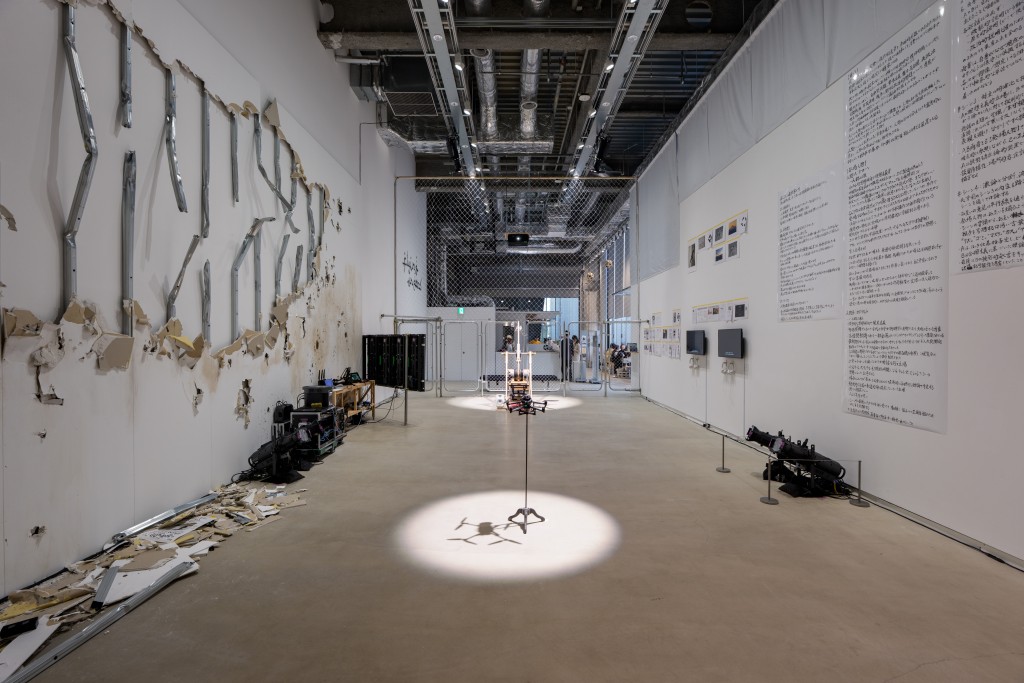
This review focuses on the concept and scope of yang02’s solo exhibition, Flying Organs, held from February to March 2026 at BUG, located next to Tokyo Station. The exhibition opened two weeks after the quickest House of Representatives election since WWII: only 16 days after the dissolution of the lower house, the Sanae Takaichi-led Liberal Democratic Party secured a landslide victory. The very survival of Article 9 of the Japanese constitution—a perpetual pacifistic framework that completely renounces the use of force in international disputes—faces threat eighty years after the war. What is at stake, then, for art today?
Born in 1984, the artist yang02 has previously made cynical works in which he deploys autonomous devices and prompts machines to replace human creative acts. His interest lies in the ambiguity of technology as well as theories surrounding its role as an extension of human organs. Once put into practical use, human technology has the potential to be employed for political purposes and warfare, and yang02 critically interrogates it. Although the ethics around technology have frequently been questioned in the arts, this exhibition stands out in its direct confrontation with the topic: the work does not allow those who encounter it to look away.
Here, yang02 creates a pseudo-humanistic piece of theater, in which an anthropomorphic drone and catapult act out an AI-generated script. The personalities and ideological backgrounds of the drone and catapult are prescribed by prompts that dictate the overall script and also serve as the basis for the actual dialogue. There are numerous versions of the plot combinations defining how the four scenes develop, and with each performance, the script is rewritten and direction updated in real time. As frequently seen in yang02’s works, the machines and their voices, as well as the sound, lighting, and video projected on the screen, all operate with some degree of limited autonomy. The farce in which the characters engage begins and ends on one side of a wire net; we remain as observers on the other side, safely protected by a fence and out of the stone’s reach.
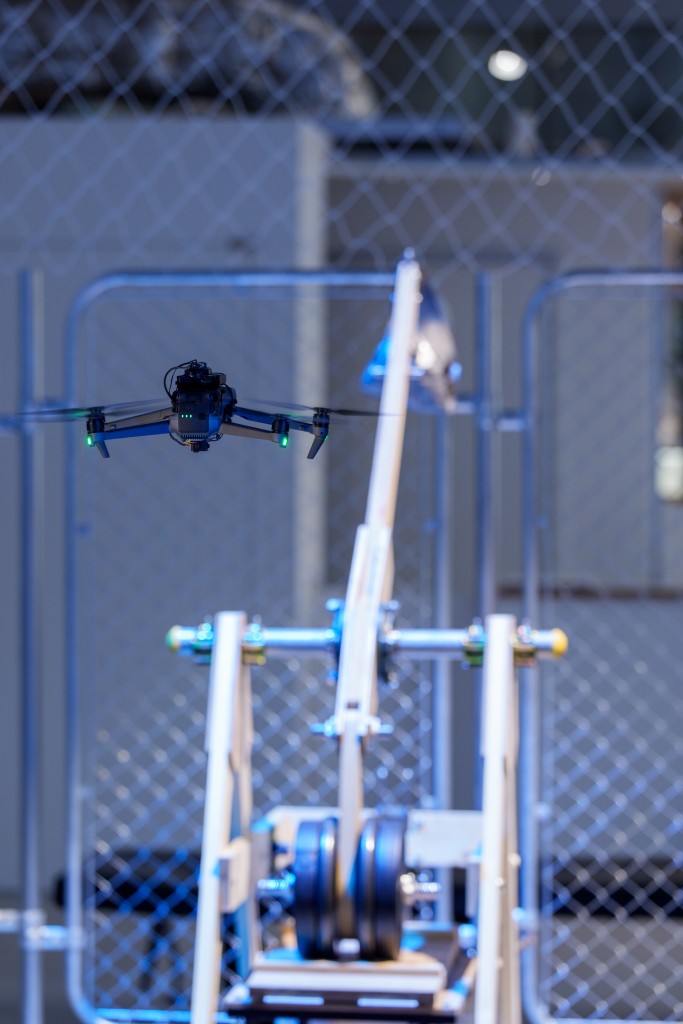
Catapults carry a long history. They were developed in Greece in the 4th century BC during the military campaigns of the Macedonian Kingdom, and in China in the 5th century BC. They are primitive devices that use the principle of leverage and material elasticity to destroy castle walls by throwing materials such as stones. Eventually, these weapons came to throw other things such as flammable substances, filth, or corpses. Even after the advent of artillery, catapults continued to be used for limited purposes into the modern era. On the other hand, camera drones are a relatively new dual-use technology. Today, autonomous drones are used for military purposes as AI research continues to develop. First deployed for reconnaissance during the Vietnam War, drones were soon recognized for their utility as attack aircraft and as weapons to carry explosives. Unmanned drones that can be remotely controlled via satellites no longer require the pilot committing killings to be physically present on the battlefield. Wars are ongoing as we speak in which our organs—extended far beyond our bodies—have gained forms of autonomy beyond our control.
It would be fallacious to suggest that the artist’s intention was to argue for alternative uses of technology outside the military. The drone in the piece, a sensitive character who struggles with its own contradictions, laments that small reconnaissance planes are meant to catch a glimpse into people’s peaceful lives, and that humans were the ones who made the mistake of loading them with explosives. The drone protests that humans must continue to strive for a better future instead of creating technology that destroys things. When technology is called a pharmakon (φάρμακον)—simultaneously remedy and poison—this does not indicate that a given technology’s use is what makes it one or the other. Seeing technology as leading to happiness if used with good intentions and violence if used with bad ones fundamentally misunderstands the “pharmakon” concept. Rather, technology is literally and intrinsically both remedy and poison, each encompassing the other in the manner of a twin spirit. Human history can testify to the fact that whenever a technology is invented, it has always resulted in military use if the possibility exists. Nobel’s dynamite, Oppenheimer’s atomic bomb, drones, and AI are all inarguably servants of war. In face of such realities, the humanism portrayed in this work—in which the artist opposes a “snobbish, contemporary” drone with an “antiquated, pre-modern war-like” catapult—comes off as much too naive.
As a side note, the coincidental overlap between catapults and drones carries a symbolism that goes beyond the intentions behind this work. While the catapult is a traditional projectile-launching device, it also appears in the name of aircraft catapults, which launch fixed-wing aircraft at high speeds from aircraft carrier decks. Aircraft catapults were primarily installed on battleships and cruisers in the US during both World Wars as acceleration devices to facilitate the launch of reconnaissance seaplanes. The Imperial Japanese Navy also installed mainly gunpowder catapults on their cruisers and battleships. While the Kamikaze Special Attack Units carried out suicide attacks where pilots sacrificed their lives as human bombs over a ten-month period near the end of WWII, records show that in May 1945, unmanned Zero fighters were launched using a catapult-like acceleration device to assess the effective firing angle when evaluating such suicide attacks. Thus the name “drones” encompasses forms of technology that continue to quietly make leaps without risking any lives—whether it be the lives of battleship crews adrift on the ocean warfront or the Kamikaze pilots who crashed their bodies into enemy ships.
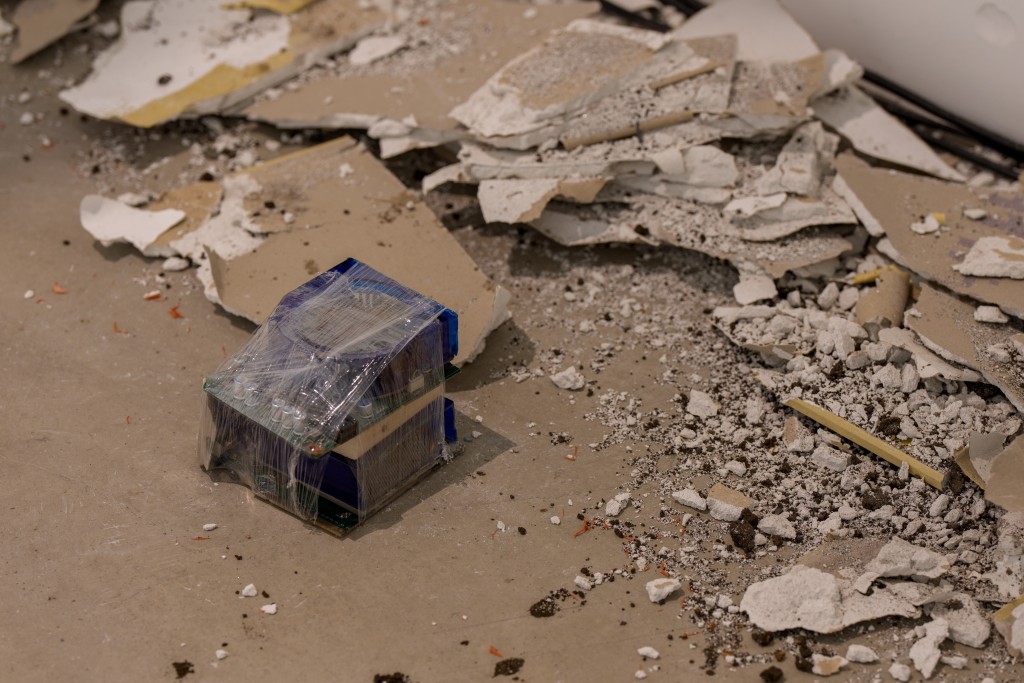
In the work, the catapult musters up all its might for a shot that flies past the drone and hits the wall, creating a dull sound. The installation wall has already been pre-destroyed, as if bombarded, with debris scattered across the floor. On the wall are documents about the “two walls rule” that people in Ukraine have adapted in their homes, and the design of the exhibition’s flyer evokes scenes of wartime destruction in Gaza. Born in 1926, my maternal grandfather worked his way up the Naval Aviator Preparatory Course, which produced many Kamikaze fighters, and remained a courageous man throughout his life. My other grandfather became a prisoner of war upon Japan’s defeat and survived through five years of detainment in Siberia, but never once talked about his experience. Both of them have now passed. Have we come to a time where we now have forgotten about war? Do we no longer have an understanding of what it was like? Are the realities and everyday lives of people in Ukraine and Gaza simply things happening in another world, far beyond our imagination? I beg to disagree—we are living in the same world as these people, fully and presently.
The “organs” that yang02 references in this exhibition first and foremost point to our physical organs now extended as tools, but also refer to technology itself, which reflexively prompts us to question our own identity as human beings. Technology is intrinsically self-editing. AI flips our minds upside down, influencing them, re-composing them. Technologies created for biopolitics update our sense of bioethics, questioning the very meaning of life and death and of ontology itself. Everything comes back to the politics of the city. From ancient Greece to today, war continues to serve as a political tool. War is a rational technology—in other words, technology itself.
I praise this work for the issue that it focuses its scope on. Media art has been defined as artistic creation using technology. More often than not, self-referential acts in media art merely highlight the joy, surprise, and the subsequent expansion of our perception when we re-encounter our extended organs. This work protests against a kind of deathly silence that suggests that if real life is tragic, art must represent peace. It questions the meaning of us all living in the same world as every past and future experience on this earth is inherited by our floating organs. I invite you to become a witness.

