


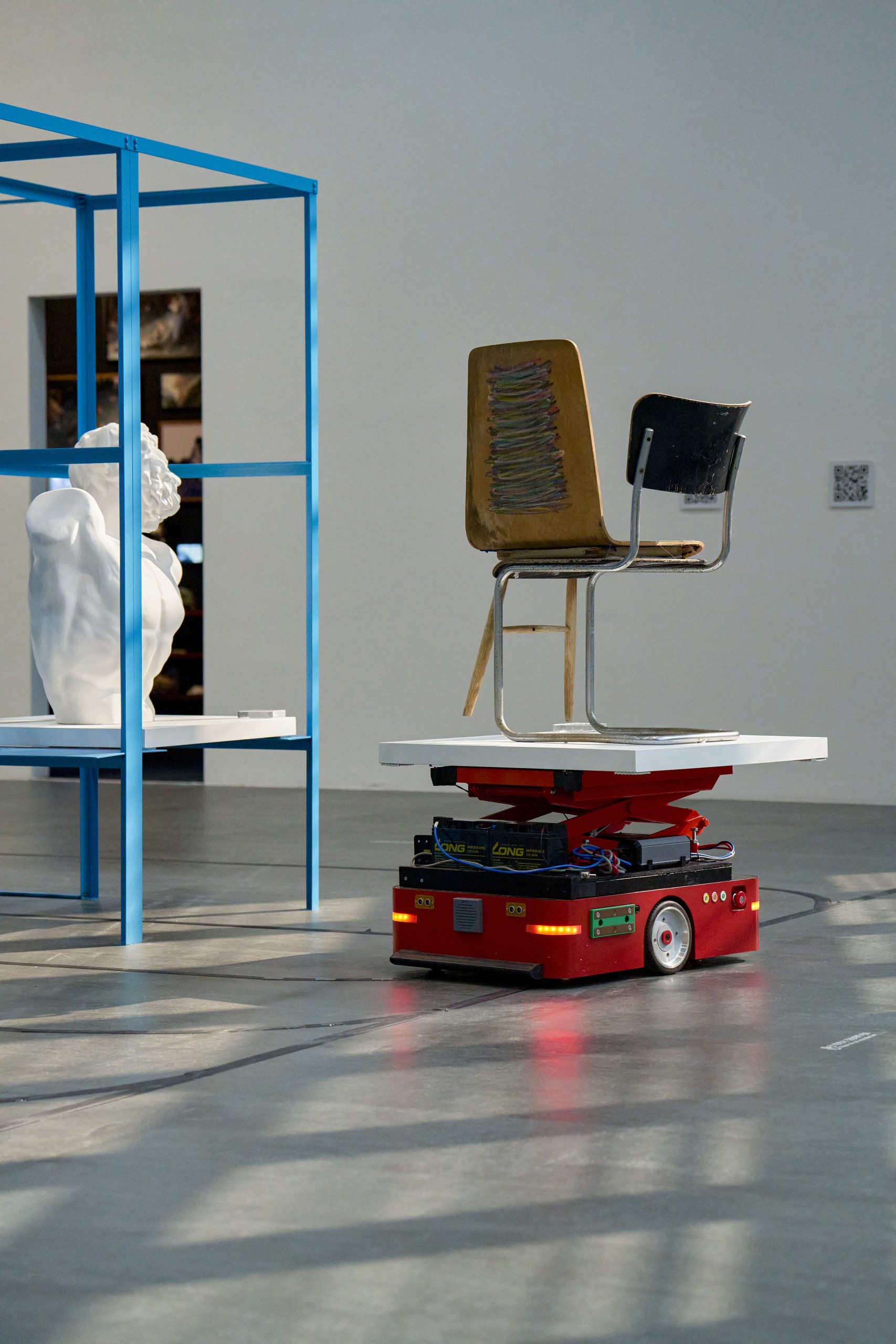
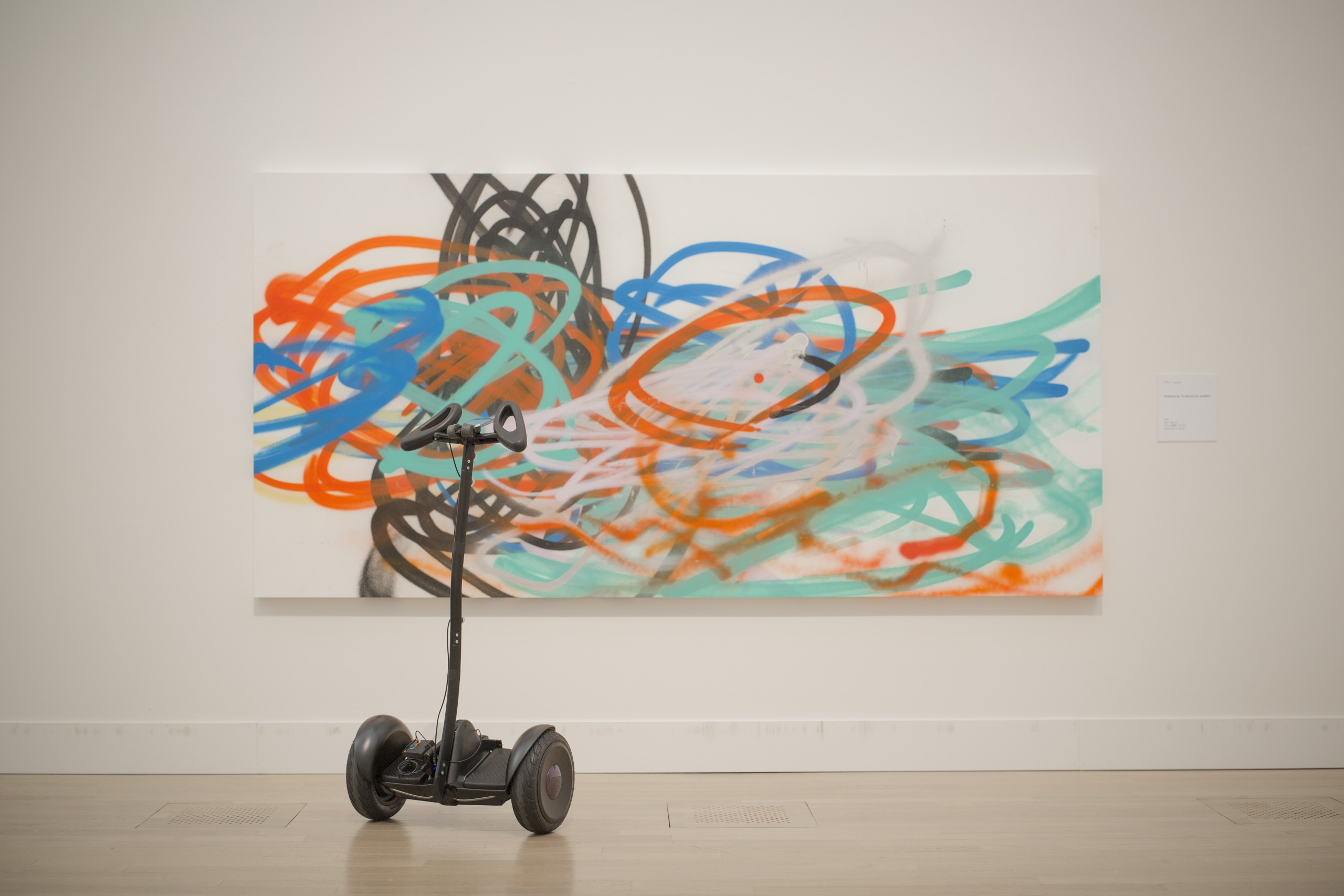
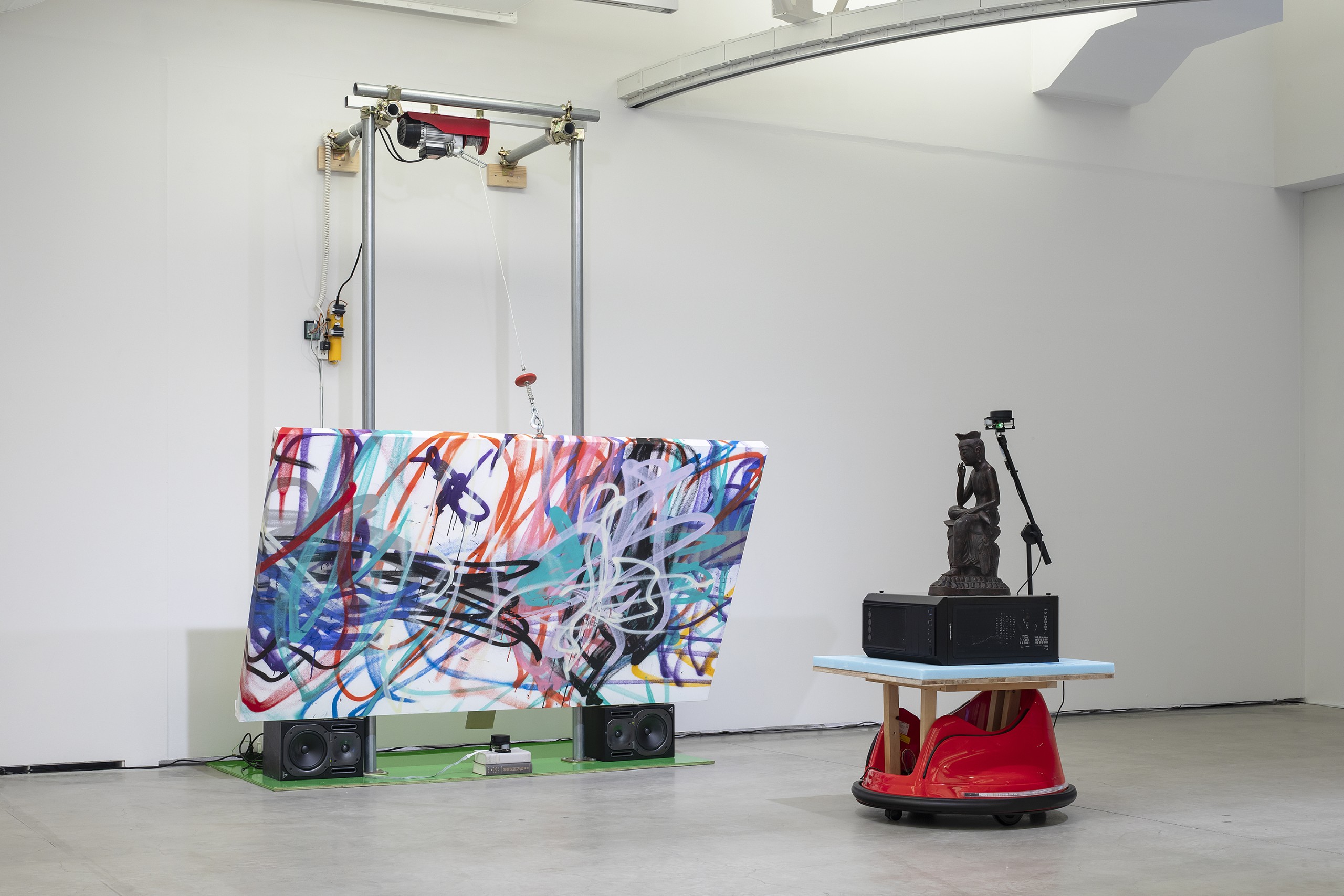
BUG, operated by Recruit Holdings Co., Ltd. is pleased to present a solo exhibition by yang02 “Flying Organs” starting Wednesday, February 25, 2026. yang02 has previously presented works utilizing technologies like AI and Segways, casting a critical gaze toward progressivism and capitalism. The artist also attempts to re-examine the physicality and subjectivity of humans in relation to these technologies.
The exhibition title “Flying Organs” refers to the state where technology, as an externalized “organ,” can be detached from its foundational “organic body” and reconfigured. Simultaneously, it represents the reality that technologies like drones and AI, from their flying positions, have substituted for human organs such as eyes, hands, and brains, and have sometimes been utilized for violence, including war. In this exhibition, yang02 questions how we should confront the nature of technology and the current realities it engenders. Please experience the new work, which fully utilizes BUG’s ceiling height (7.2 meters), featuring AI-equipped drones and devices attempting to shoot them down, engaged in repeated dialogue.
About the exhibition
The significance of the exhibition title
“Flying Organs” refers to a state in which “organs” that were once grounded in an organic body are externalized as technology and detached from the body, becoming capable of being rearranged independently. This concept is informed by philosopher Bernard Stiegler’s theory of generalorganology.
Stiegler viewed human beings as fundamentally lacking entities, beings that come into existence only by compensating for this lack through prostheses such as tools and technology—as in the myth where Prometheus gave fire to mankind. In this framework, technology is not a mere accessory but a complementary element that underpins human existence itself. “Technology” can be described as an “external organ” that inscribes abilities and memory outside the body and enables their transmission across generations. This technology, as an “external organ,” functions as an infrastructure mediating between individual mental activity and social institutions. For example, the technology of “writing” is not only a means of recording personal thought and memory, but also a foundation for systems that govern society, such as law and contracts. In this sense, human beings have continuously reorganized their perception, thought, and even social structures alongside transformations in technology.
Viewed from this perspective, contemporary technologies such as AI and drones now substitute for human eyes, hands, and brains, operating beyond physical and spatial limitations. Organs once rooted in the body have become detached and reconfigured within society as “flying organs.” While this state of “flying” opens up new possibilities for reorganizing organs, it simultaneously drives humans into a condition of “suspension,” unanchored. It carries within it the peril of transforming their senses, thoughts, and indeed social structures to the point of becoming uncontrollable. As Stiegler pointed out, technology is both a “remedy” and a “poison” for humanity. In the present day, technology functions not only as a useful tool, but is increasingly tied to surveillance, control, and even violent forms of “selection between life and death.” This exhibition revisits these conditions, examining how “flying organs” operate within society today and how they transform human perception and ethics.
New Work Featuring Drones and Catapults Interacting Within a 7.2m High Venue
Taking full advantage of BUG’s 7.2-meter-high ceiling, this exhibition presents a new work in which an AI-equipped drone and a catapult attempting to shoot it down engage in an ongoing dialogue. The drone flying through the venue is a DJI “Mavic 3”, the same model deployed in actual battlefields. The dual-use nature of this technology—a drone developed for civilian purposes like aerial photography now deployed on the front lines—manifests within the venue. The venue is divided by netting and wire mesh, through which visitors observe the dialogue and tension between the two entities (the performance is scheduled to take place once every hour). Outside performance times, visitors are able to enter the enclosed area to view exhibition materials and objects launched by the catapult up close.
Drones, the latest military technology, and catapults, ancient weapons. Both engage in a dialogue from their respective perspectives, addressing the memories of violence etched into land and structures, the feudal conditions accelerated by giant tech corporations, and the history of exploitation imposed upon specific places. In response to the unfolding dialogue, the catapult launches objects toward the drone. Through this relationship, the exhibition seeks to render perceptible—on a bodily level—the power structures of contemporary society and the ways in which individuals are implicated within them.
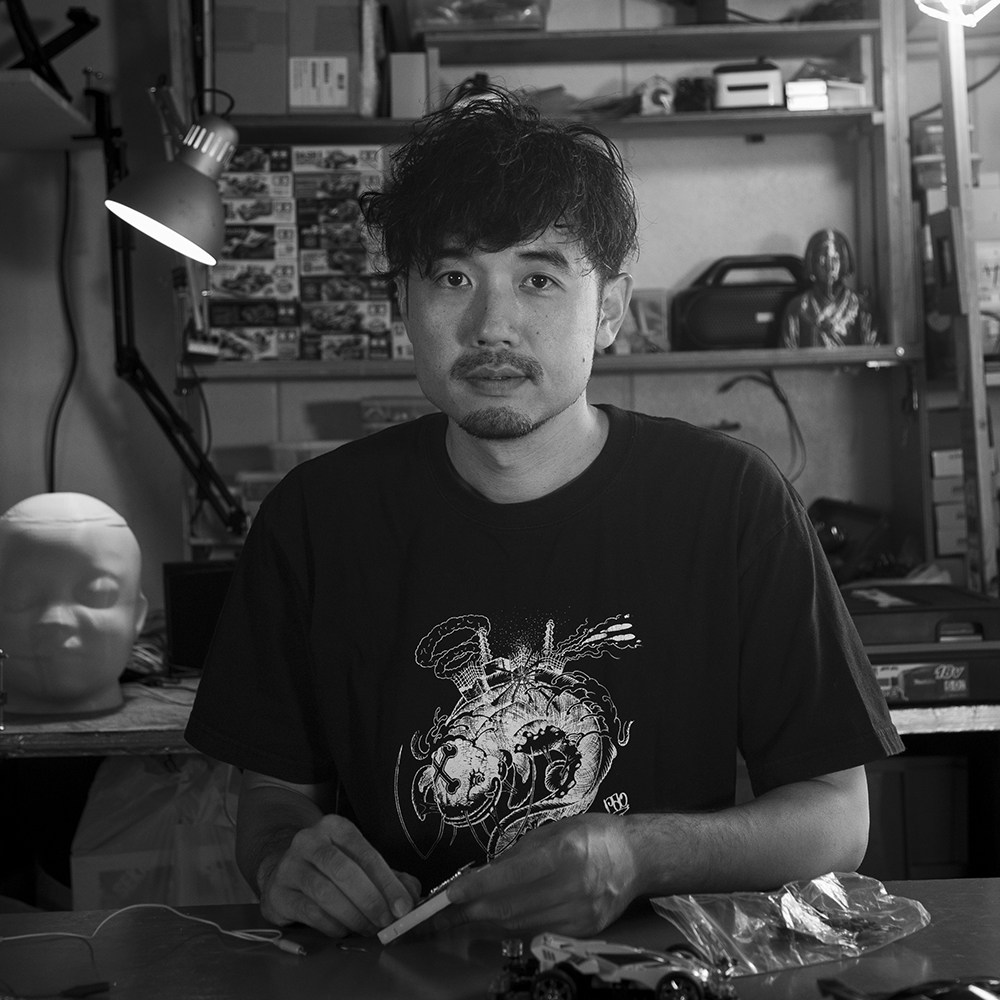
Born in Kanagawa Prefecture, 1984. Presents works in formats including two-dimensional pieces, sculptures, installations, and performances. These combine contemporary technology-driven kinetic devices with existing information systems or discarded materials through misuse, repurposing, or hacking. Recent major exhibitions include “MOT Annual 2023” (Museum of Contemporary Art Tokyo, Tokyo, 2023), “Roppongi Crossing 2022: Coming & Going” (Mori Art Museum, Tokyo, 2022).
開催情報
2026.2.25(WED)– 4.5(SUN)
11:00 — 19:00
Tuesdays
Free
BUG

