

Nakamura Yuko (Specially Appointed Research Fellow at the Center for African Area Studies (CAAS) at Kyoto University)
Is There Really a Door Only Art Can Open? : Stepping Beyond the Colonizer’s Safe Zone
Preface:
It is the early days of summer in 2026, and my Instagram feed shows me glamorous updates from the Kenya Pavilion at the Venice Biennale, an artist friend from Nairobi who is now based in Paris, and a Nairobi-based collective that works across many different African cities. At the same time, there are people living right beside these locations in conditions that seem worlds away.
A video at the exhibition’s entrance shows the sprawling landscape of the “slums” of Kibera against a backdrop filled with high rises in Nairobi. The city—which was built by colonizers for colonizers—has limited or excluded housing for African people throughout the country’s colonial era. Despite this fact, migrant workers have expanded their living space by at times resisting or abiding by these regulations. Urban anthropologist Matsuda Motoji has argued that the migrant workers’ practice of “taming the city” is the city’s defining characteristic.[1]
The shift from object to subject is the central theme in this exhibition, something that has been touted for more than 120 years since African countries were under colonial rule,[2] and in a sense, may feel familiar to most viewers. However, the art world—which has advocated for diverse inclusion throughout the process of so-called globalization in the latter half of the 20th century and onward—has taken advantage of the people who built these cities, objectifying them while stripping away their subjectivity.
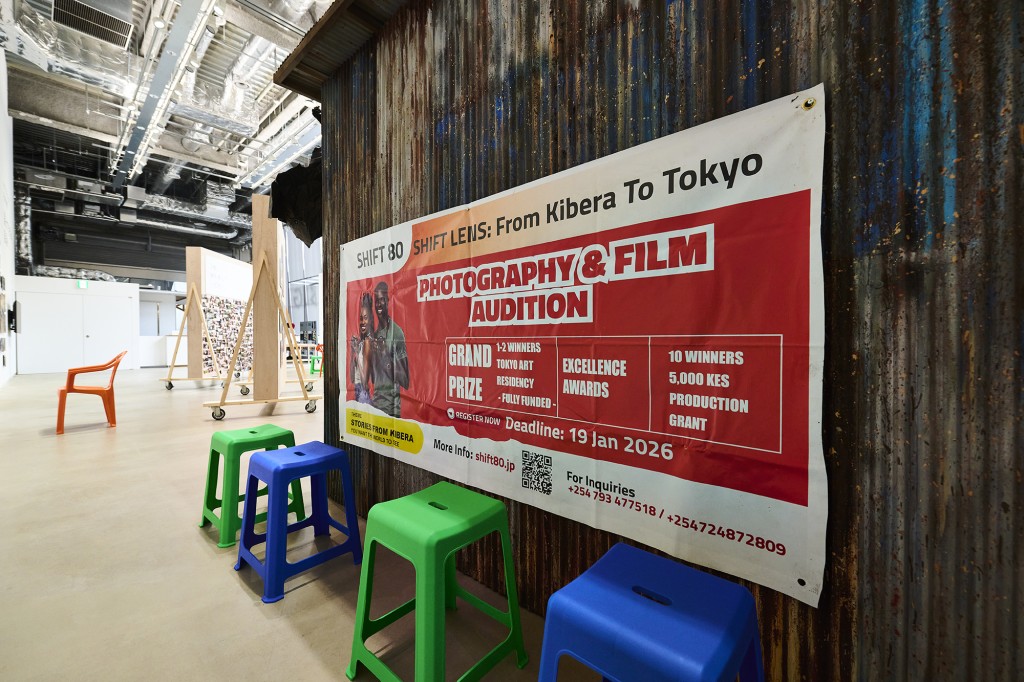
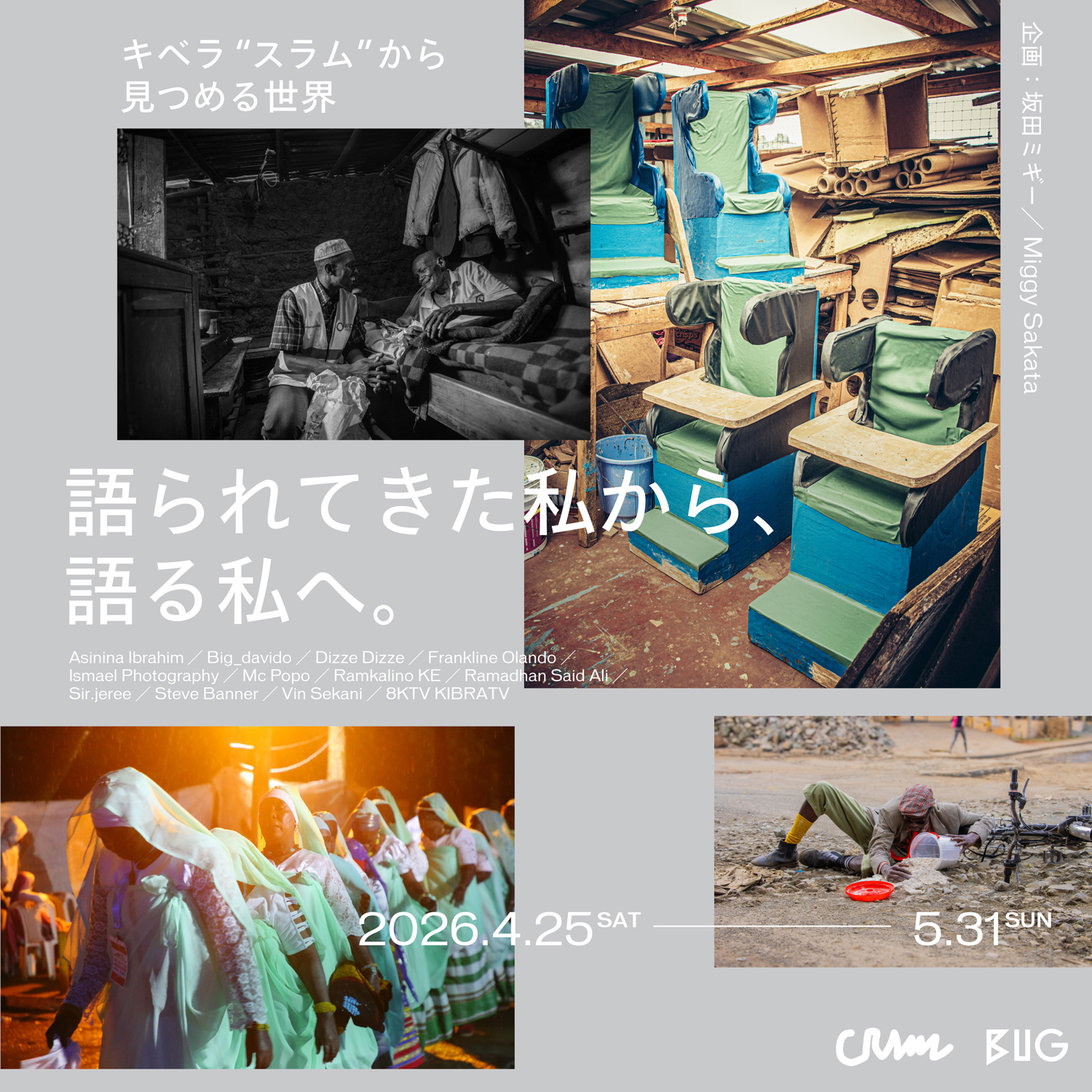
The organizer of this exhibition is Miggy Sakata, who was selected through Art Center BUG’s CRAWL program for art workers (planners). Since 2013, Sakata has been supporting educational and business initiatives in the Kibera area of Nairobi, and as she herself notes, she is not an art worker in the narrow sense. Instead, she has stepped outside of the comforts of colonial power dynamics—such as the white affluent neighborhoods where Japanese expats reside or the touristic staples of the safaris—working alongside people whom the art world has long neglected. This exhibition was realized through her project KIBERACTION, which donates used cameras from Japan and provides local youth with photography and video skills mentorship. Out of 32 applicants, 12 artists were selected for this exhibition, some of whom came to Japan to do a residency. The exhibition’s subheading in Japanese has quotations around the word “slum,” and indeed, the show contains works of photography and video by people who have embarked on their journey as artists from Kibera, not as aid recipients from the slums.
1.
The most memorable work is Objects on the Mirror May Look Closer Than They Are by Vin sekani, a 13-minute video about Jemo, a pious and hard-working young man, and the employment struggles that surround him. In an environment where even a classmate with high grades can only land a job as a bus conductor, Jemo and his peers support one another to make ends meet. But chances keep slipping through their fingers. Those who are economically successful merely preach faith in God. While Jemo continues to believe that a door will open for him, he faces impossible economic hurdles. This cyclical repetition is something that sekani depicts as simply part of everyday life. Jemo finally makes the decision to join a protest, only to lose his life due to the forces of political repression. The work was played on loop at the venue, and every time the protagonist appeared on the screen leaving his house full of hope, wearing a crisp shirt and pointing towards the sky, I felt my chest tighten up.[3]
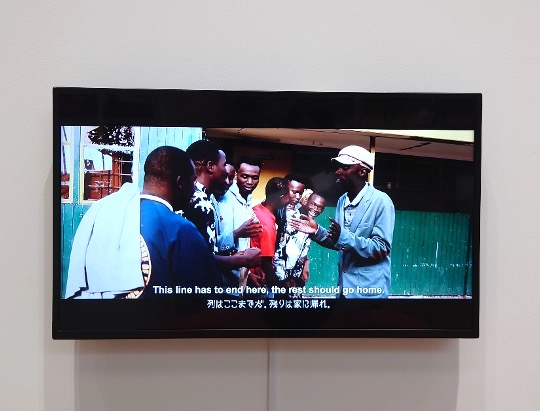
I learned that the story is based on a real-life experience of the artist’s friend. Even if sekani’s intention was to simply shoot a specific and personal experience, the work had the depth to show how the vestiges of colonial rule and setbacks in nation-building affect an individual’s life. The indescribable sensations I felt in Benin—toward the almost-frustrating (from an outsider’s perspective) reliance on “God,” the helplessness people feel about the enormous structures that entangle them, and the relentless repetition of daily life—seemed to magically emerge on the screen. Instead of reducing a young man dying in a protest to a statistical number in the headlines, the work also shows us that one friend passing down the story of a tragic end to another’s life is a powerful act of collective memory.
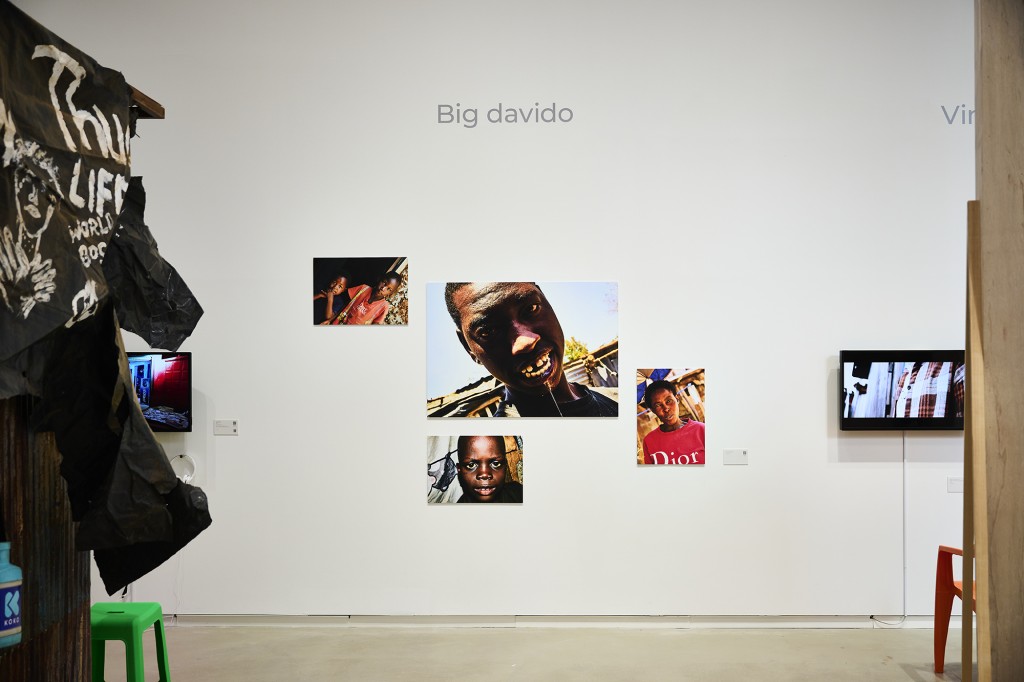
On the other hand, the photography works contained, frankly, images that appeared similar to other photographs portraying cities in West Africa that were already familiar to me. My perspective of these works changed, however, once I learned more about their context. For example, the work Faces of Kibera by Big_davido shows a portrait of a man with his mouth slightly ajar, who I later learned is a drug addict. Through the eyes of the photographer, the image of this man as simply a neighbor—one that is not only impossible to capture as an outsider but also would be imperceptible to begin with—emerges for the first time.
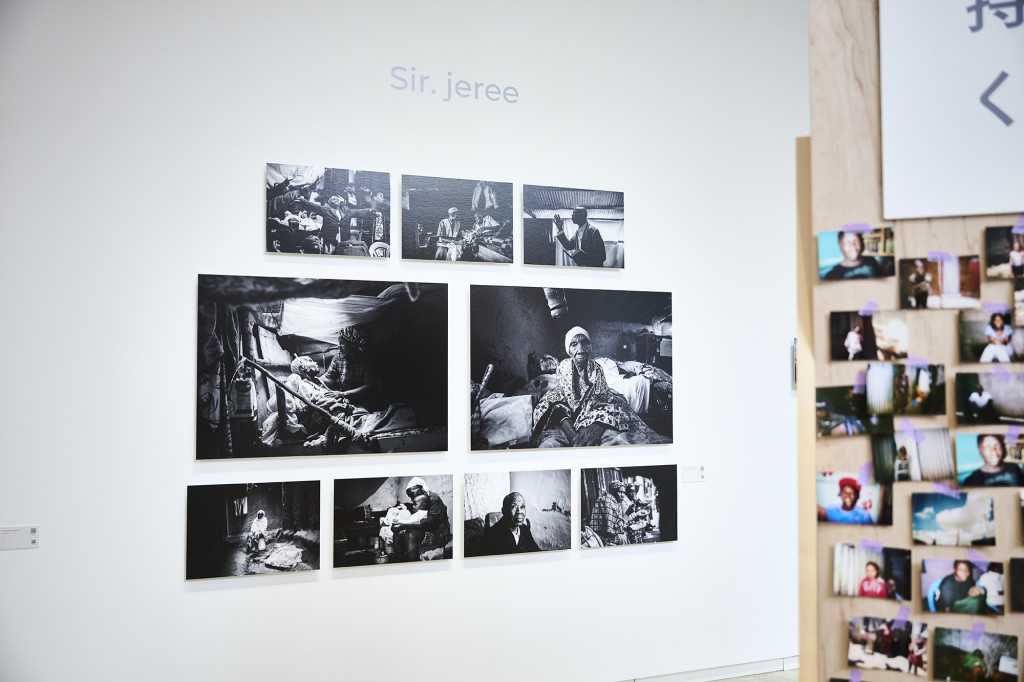
The figures adjacent to old age or death in SASA WAKATI ULE by Sir.jeree, who volunteers at a nursing facility, would also be impossible for outsiders to casually portray. According to Sakata, not only was a documentary team from France recently pelted with stones, but she herself hired a local security team when transporting larger equipment for a workshop. The fact that these artists from Kibera are able to portray life there in a similar way to that of a West African city is, in and of itself, a huge accomplishment.
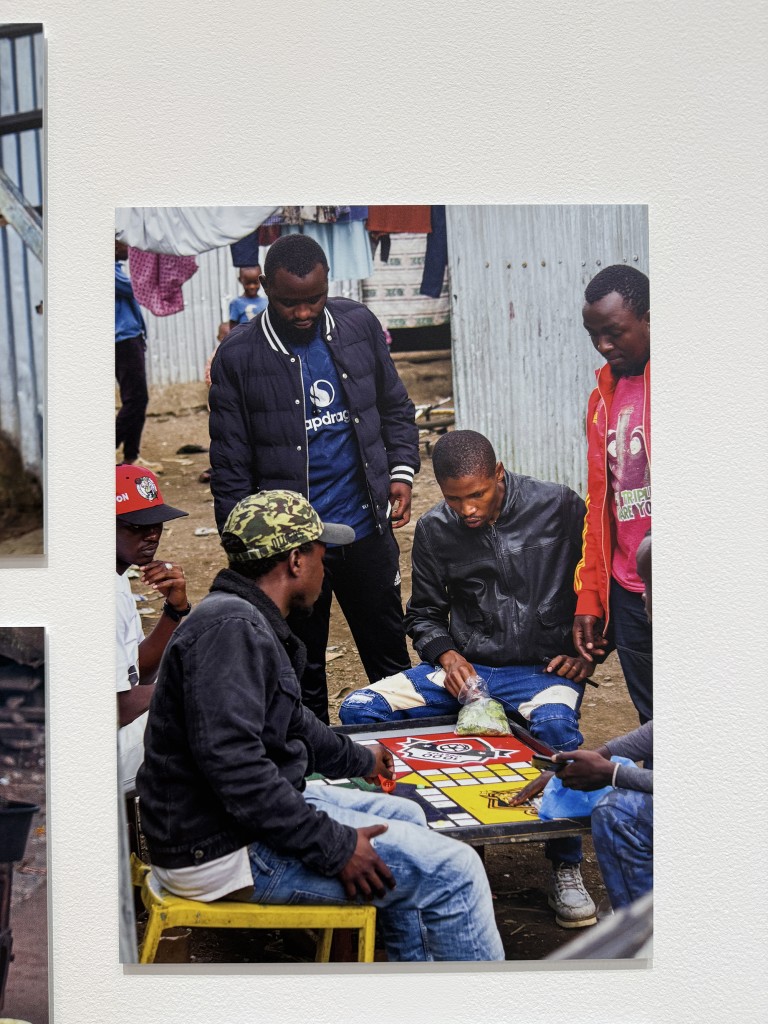
Consider also the images of basket weaving on street corners, and the vendors who sell grilled fish. A familiar sight in Cotonou and Porto-Novo as well, I learned that the raw materials usually free of charge in such “farming cities” must be purchased in Kibera. Life here is impoverished, and yet cash remains indispensable. Reflecting on this reality conjured an image in my mind: goods and small change quietly passing from hand to hand day in and day out. I was also told that some people have relatives who fish at Lake Victoria, so they are able to at least obtain fish for free. This in turn makes the reference to environmental pollution in ANGRY HUNGER resonate even more deeply.
As I yearned to learn more about these circumstances behind the works, I was also aware of the dilemma that comes with making them explicit, something that, whether focusing on the hurdles or the “resilience” of the people who live there, can lead to foregrounding the “slum” quality. This exhibition chose to shed light on the “Kibera” aspect of the place, rather than the “slums.” The show may appear bright and light-hearted despite its themes, but against this backdrop, we see an effort by each artist to present their own image of Kibera from the ground up, rather than strategically utilizing existing lexicon regarding its slum qualities.
With all of these things considered, I do think there was one aspect that should have been more clearly emphasized in the show. Kibera is often considered to be a temporary stay for migrant workers, but there are generations of people who have been born and raised there that are slowly developing a local Kibera identity. Works such as Nubian Roots and Belonging in Kibera— Nubian Life and Identity propose, as their titles suggest, a sense of belonging to this place and an awareness around one’s roots. Through this lens, the works that grapple with death and aging begin to appear differently. After all, aging and death are natural contrasts to being born and growing up. I saw potential in the formation of identities tied to a certain place and the transitions between generations being narrated through the artworks and the curation.
2.
In this section, I would like to give an overview of how African photography came to be recognized as “fine art.” One of the central places in this movement is West Africa, represented by countries such as Mali and Senegal. Amid the African contemporary art boom that began in the 1990s, the works of studio photographers were being discovered by Western curators and collectors, gaining recognition as contemporary art. A famous example is Malick Sidibé, who won the Golden Lion Award for Lifetime Achievement at the Venice Biennale in 2007. Nowadays, West African studio photography has been historicized as the basis of research on modern African visual culture.[4] Against the currents of getting “picked up” by the West, continental art festivals such as the Bamako Encounters (Mali) were launched in the 1990s, beginning the process of constructing a platform to reclaim Africa’s sovereignty.
South Africa constituted the other center with an accumulation of artists across generations, from photographers who showed the world what apartheid was, to artists who continue to depict Black queer communities.[5] East African artists were also represented in A World in Common (2023-24), a large survey exhibition at the Tate Modern.
What is the relationship between the people of Kibera and photography, then? As “objects,” countless examples can be seen in the myriad documentaries by visiting photojournalists, or JR’s Women Are Heroes project (2007-2009; residents did participate but the project was led by an outsider). On the other hand, a tradition toward subjectification is not non-existent. One of the books on display at this exhibition was Shootback (1999), a record of exhibitions and publications of photographs taken by children in the Nairobi slum of Mathare who had been given plastic cameras. In recent years, Kibera-born photographer Brian Otieno has continued to capture images of daily life in Kibera as a way to resist stereotypical “slum” images.[6] It is noteworthy that this exhibition, which directly connects to this tradition of subjectification, was proposed and realized from outside of the art world. It feels particularly important that the project involved an open call and screening process aimed at the community. As explored in sekani’s work, those in the position to select do not have the administrative bandwidth to do so, which normalizes unfair screening processes. A fair screening process itself can embody a sense of hope.
Art Center BUG could have intervened on an aesthetic and theoretical level to make this exhibition appear more “art”-like. However, the existing lexicon around art—including those that critique Western-centrism and imperialism—has been generated by marginalizing those who live in places like Kibera.[7] I would like to express my respect for the project’s approach, which began with the realities of the communities, to faithfully present the current situation on the ground.
3.
I learned that participants in this exhibition include people working professionally, and many of them hope to build their careers as artists or journalists. In either industry, the Western-centric career trajectory remains powerful. However, as mentioned above, there are places created by predecessors who understood the dynamics surrounding art and sought to restore sovereignty to Africa. Ethiopian photographer Aïda Muluneh, who has a background in journalism, launched Addis Foto Fest, the first international photography festival in East Africa in 2010, overseeing everything from photography education to setting up the appropriate printing facilities.[8] Muluneh cites her participation in the Bamako Encounters as a source of inspiration, revealing the generational layers of efforts that resonate to this day. In Nairobi, artist Kaloki Nyamai opened the residency Kamene Cultural & Research Center in 2023, accompanied by Kenya’s first art library. The Uganda-based Uganda Press Photo Award (UPPA, founded in 2012) also runs East African Photography Award (EAPA) under its parent organization FOTEA and manages youth mentorship programs.[9]
A more healthy career path in which artists can refine their practices within an East African/Swahili network that shares common values and the realities of the region is becoming more tangible. Local connections play an important role in escaping the limitations imposed by the state as well. We in the Japanese-speaking world should unlearn an attitude that attempts to “pick up” talent from Kibera and instead look toward a future in which we are learning from Kibera’s latest visual expressions and accumulation of knowledge.[10] In its introductory text, the exhibition declares that it seeks to reexamine the fundamental power of expression and the joy it can generate. Does art—which has historically neglected the agency of people in places like Kibera and prioritized its own enrichment while calling for ethics and inclusion—even hold such a possibility? And yet, here we see people who have entered this field believing there is a door that can only be opened through expression. This exhibition, for one, has proven that such a door can indeed be opened.
[1] Matsuda Motoji. Toshi o Kainarasu: Afurika no Toshi Jinruigaku [Taming the city: urban anthropology of Africa]. (1996; reis., Kawade Shobō Shinsha, 2026).
[2] Chika Okeke-Agulu, “Introduction: On Modern and Contemporary African Art and Artists,” in African Artists: From 1882 to Now, ed. Rebecca Morrill and Simon Hunegs (Phaidon Press, 2021).
Art historian Chika Okeke-Agulu identifies the starting point of modern African art as West African painter Aina Onabolu (1882–1963). His portrait paintings, which depict the elite class of Lagos using Western academic painting methods, was an attempt to resist the racist discourse that argued “Africans can neither understand nor participate in modern society,” and represent Africans as modern subjects (the year 1882 in the book title refers to Onabolu’s birth year).
[3]CHOREA by Ramkalino KE was also on display at the exhibition, presenting an image of Kibera distinct from that of a slum that reproduces violence and poverty. It is a video work featuring a young man who, despite his repeated crimes in the past, has a change of heart and decides to attend church to correct his ways. In this way, sekani’s work could be seen as depicting the injustice that lies beyond this point.
[4] Okwui Enwezor and Chika Okeke-Agulu. Contemporary African Art Since 1980. (Damiani, 2009).
This text positions the rediscovery of Seydou Keïta as the fundamental trigger that enabled works by Malick Sidibé and Samuel Fosso to be appreciated.
[5] These include Ernest Cole, who documented the system of apartheid, and Zanele Muholi, who continues to capture Black queer people. The KYOTOGRAPHIE 2026 special feature South Africa In Focus and its accompanying photobook exhibition is also still fresh in our minds. The photobook exhibition was a collaborative project with A4 Arts Foundation, a laboratory for the arts founded in Cape Town in 2017. A4 supports artists and art workers while also opening up their facilities, including a library, exhibition room, and residency space, to the public. These kinds of multifunctional art complexes have been playing a large role in grassroots development of African contemporary art.
[6] There are prior examples of art projects started in Japan that focus on Kibera. Nishio Yoshinari has been collaborating with Maasai Mbili Artist Collective, an art collective based in Kibera. According to Nishio Sakiko’s master’s thesis, “Study on Contemporary Visual Art in Nairobi, Kenya: Representation of Slum and Neighborhood Social Relations by Artist Groups Based in Informal Settlements” this collective has been working with local communities while also practicing strategies that represent these slum qualities to the art world.
[7] For example, Nakamura Tohru’s Watashi ga Shotō de Aru: Karibukai Shisō Nyūmon [I am the archipelago: an introduction to Caribbean thought] published by Shoshikankanbou in 2023 provides a detailed account of how ideas unique to the Caribbean have been dismissed and distorted when interpreted through the lens of postcolonialism developed in the West. Based on my own experience of visiting international festivals and museums and participating in discourses around art in Japan, I have become painfully aware of an issue whereby regional experiences are forcibly subsumed into Western notions of “Blackness” or postcolonial frameworks in the process of exhibiting and viewing works centered on Africa.
[8] In 2010, Aïda Muluneh founded the international photography festival Addis Foto Fest in Addis Ababa. She runs Desta for Africa, which focuses on photography education, and expanded the festival to Abidjan in Côte d’Ivoire in 2022 as Africa Foto Fair. She also oversees Africa Print House, which aims to provide the continent with printing facilities that are up to international standards. In terms of her involvement with Japanese companies, Muluneh is a Canon Ambassador, and Addis Foto Fest has collaborated from its beginnings with Canon’s Miraisha Programme, a human resource development initiative in Africa launched in 2014. She is proactive in leveraging technologies and funding provided by foreign electronics manufacturers.
[9] UPPA and EAPA also have ties to Canon’s Miraisha Programme. Since 2015, Canon has been the imaging partner for these awards through the Miraisha Programme, providing equipment and hosting workshops (in recent years, other companies including Fujifilm have also joined as their sponsors).
[10] Given that this exhibition was held at Art Center BUG, which is directly connected to Tokyo Station’s Yaesu South Exit and run by the major corporation Recruit Holdings Co., Ltd, I would like to touch upon the relationship between the Japanese economic world and African art. In recent years, there has been an increase in art initiatives developed as a foothold for companies to advance into Africa, such as the most recent THE TOYOTA TSUSHO CFAO African Art Award by Toyota Tsusho Corporation and others. Five winners were selected for the 2026 inaugural edition, with the exhibition touring from Lomé, Togo to Tokyo and Paris. While the award is significant in terms of creating a platform for young African artists to launch exhibitions from the continent, it features prominent curators from Europe, the United States, and Japan as the judges, which adds further external criteria. Given that some of the winners are artists who have gained recognition at international art festivals such as the Venice Biennale, there is undeniably an aspect of echoing already-established trends in the art world. From a decolonial perspective, it is crucial to return the wealth that has been accumulated by exploiting Africa, and to hand over the decision-making of how that wealth is returned to the people there; to do so requires meticulous efforts that seek to recognize the uniqueness of each person embedded within the supply chain. Art Center BUG’s accomplishment with this exhibition demonstrates that these kinds of art initiatives from the ground up are, however difficult, possible.
Acknowledgements
I received advice in writing this article from Nakagaki Taiki (from the Graduate School of Asian and African Area Studies at Kyoto University), who conducts urban studies research in Kampala, the capital of Uganda in East Africa, and introduced me to photography awards based in Uganda. I would like to express my sincere gratitude to him.
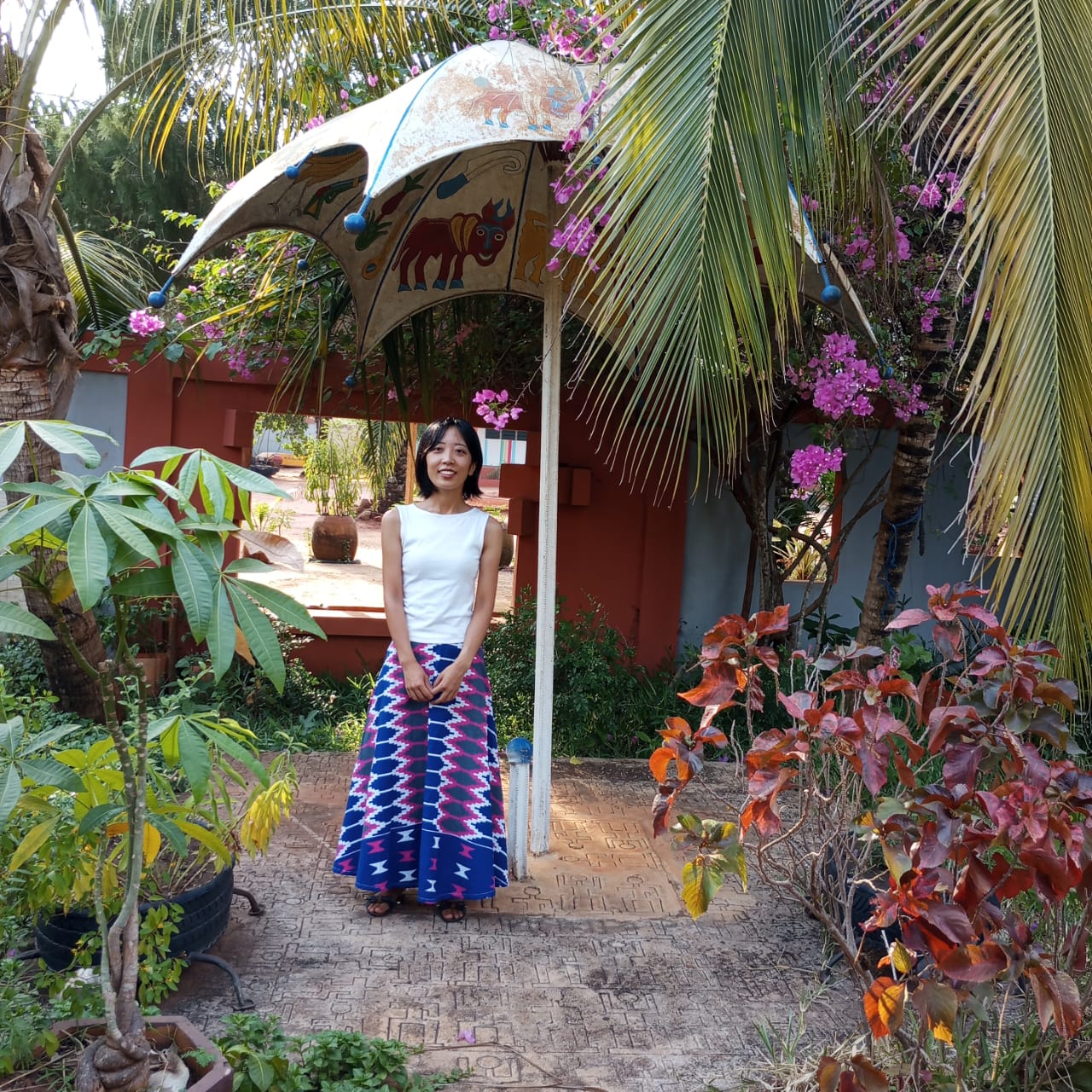
Specially Appointed Research Fellow at the Center for African Area Studies (CAAS) at Kyoto University After graduating from the Faculty of Law at the University of Tokyo, Yuko Nakamura earned her master’s and doctoral degrees in area studies from the Graduate School of Asian and African Area Studies at Kyoto University. Taking contemporary African art as a starting point, her research focuses on the boundary between art and non-art, and on how that boundary relates to areal divisions—namely, the West and the non-West, with a particular emphasis on ceramics. She conducts fieldwork research in Benin, France, and Japan.

