
Deschooling: An Open Learning Space
In considering the future of art centers, this program is particularly insightful in three respects. Firstly, instead of planning and running this project within the organization, they have actively invited outside curators and art workers to collaborate. Secondly, the collaboration continued over a longer period of three years, which allowed these relationships to deepen. Thirdly, by holding exhibitions every year, they have accumulated a series of challenges and accomplishments, to improve and adjust the program incrementally. This operational structure is very current, in that it aims to drive new developments and change through sustained involvement.
Furthermore, while premised on the universally comprehensible “exhibition” format, BUG School has the following three significant characteristics:
1)The cohabitation of participatory programs and the purchase of artworks
2)Exploring a broader framework of “support” for artists and their lives
3)Spatial design that can both contain and augment artworks and exhibitions
These three elements embody BUG School’s intention to serve as an alternative to the existing school system. In conventional education, students do not encounter artwork acquisition as a way of engaging with the arts, and the acts of selling and purchasing art are sometimes even criticized. It is also difficult to learn how to survive as an artist from a school education. Here, however, participants find the opportunity to learn in a practical manner how to engage with the arts as they live their lives. Concerned that schooling meant becoming a slave to a system where one learns to “accept service in place of value,” Ivan Illich once argued for the “deschooling” of society and the importance of an environment where we are both autonomous and supportive of one another.1 As conventional schools become more and more systemized and desensitized, there is currently a real need for “deschooled” places of learning that have not been incorporated into those systems.
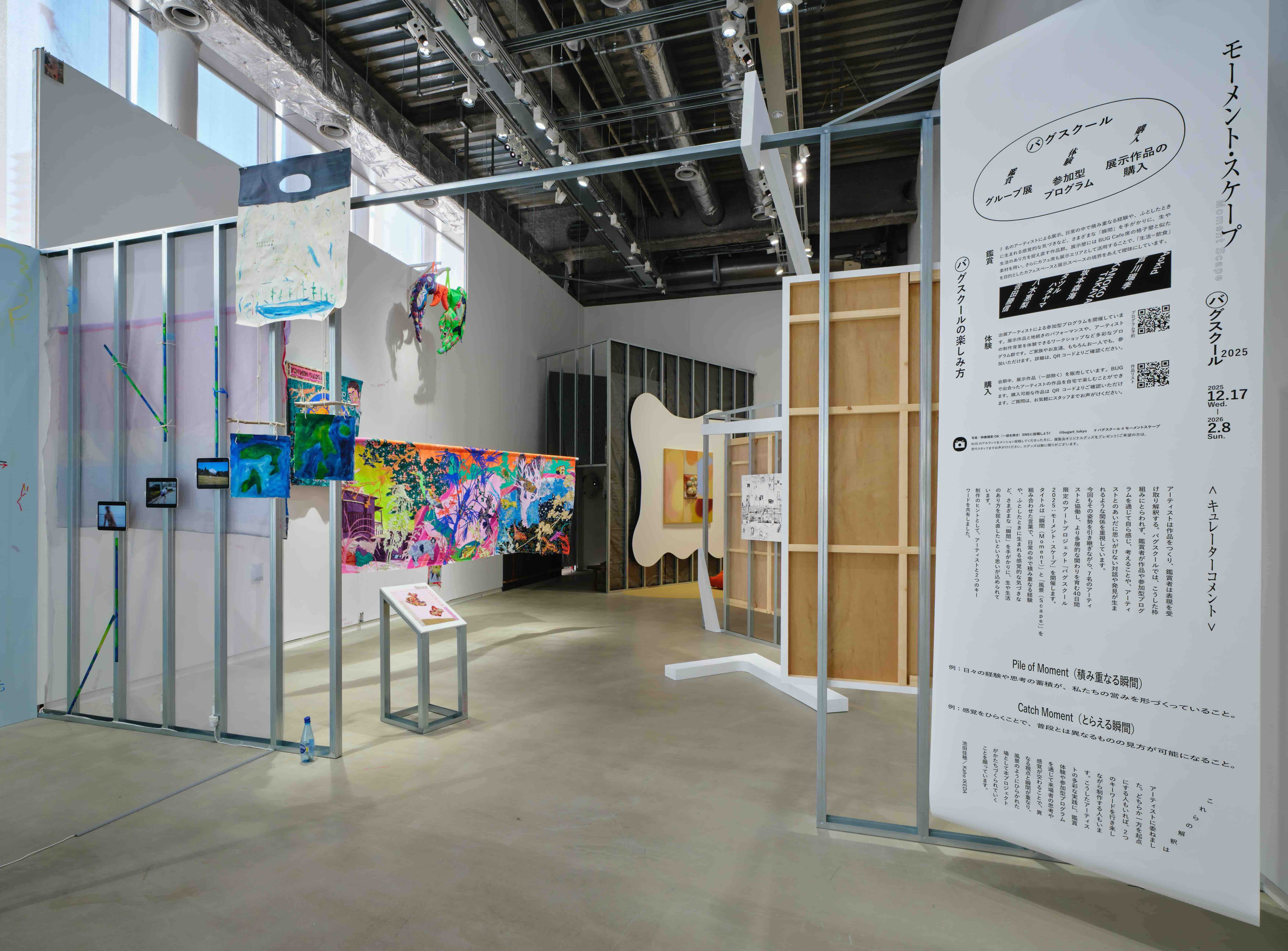
In the exhibition introduction, it is casually written that “BUG School is an art project combining a group exhibition with participatory programs and purchasing of artworks,” but it is not easy to design an exhibition that values participatory programs and the purchase of artworks equally. Participatory can mean many things, including participation in the creation process, in learning spaces to deepen understanding about the artworks, or in opportunities offering a glimpse into the thinking and techniques of the artist. This exhibition’s participatory programs are centered around workshops and talks that inspire participants to think alongside the artists and others involved in the exhibition as these professionals share their practices and thought processes. By sharing time with artists, this design encourages participants to discover their own questions and to think proactively, rather than simply giving them “techniques” or “answers.” To organize nearly thirty participatory programs during an exhibition of merely forty days, by no means a lengthy period, is itself a clear testament to this project’s attitude.
It is also worth noting that while many of the participating artists do not generally create work that is particularly conducive to sales and purchase, they all produced works and items that visitors could purchase. To begin with, it is incredibly difficult to live in this world avoiding selling and purchasing, and the act of “buying” is a relatively easy way to participate in contemporary society and a form of direct support. Curator Kaho Ikeda has been deeply committed to Shiroto no Ran (Amateur Riot)2 in Koenji, and this experience has likely influenced this system of selling artworks in no small measure. At public cultural institutions, frameworks for “public” understanding and the system design itself can become rigid, which can pose the risk of “support” becoming exploitative. In that sense, this initiative is made possible by the fact that BUG’s organizational structure and mission are different from those of the typical public institution, which has also led to its support of artists and society at large. The various learning programs and artwork sales have also functioned as a circuit that delivers the voices of viewers and participants directly to the artist.
The design of the space for the past three editions of BUG School has always been distinctive. The second installment, BUG School 2024: Feeling Cities with Wild Sense, had a large slope installed, and the artists developed their works under that premise.3 In this third installment, the space is deceptively simplistic, unlike previous editions, without any spatial elements that strongly affect the works. Light gauge steel (LGS), which is typically used as the skeleton for temporary walls, is displayed in its bare form as the partition between each artist’s zone, except for the limited installation of a wall surface where necessary. There is also an existing wall between the BUG cafe and exhibition room, but the back side of the exhibition walls and LGS frame are exposed to the cafe, matching the tone of the entire space. While respecting the individual space of each artist, creating a space without too much partitioning and allowing visitors a clearer view encourages a feeling of intimacy and openness. There is also a jovial atmosphere, similar to that of a market where small shops gather. Historically, the “market” has functioned as a place of freedom, liberated from the established power dynamics,4 and this idea, paired with the sales of the artworks creates more openness in the exhibition space. Furthermore, having a learning space also fosters a sense of comfort, as if one is relaxing at home.
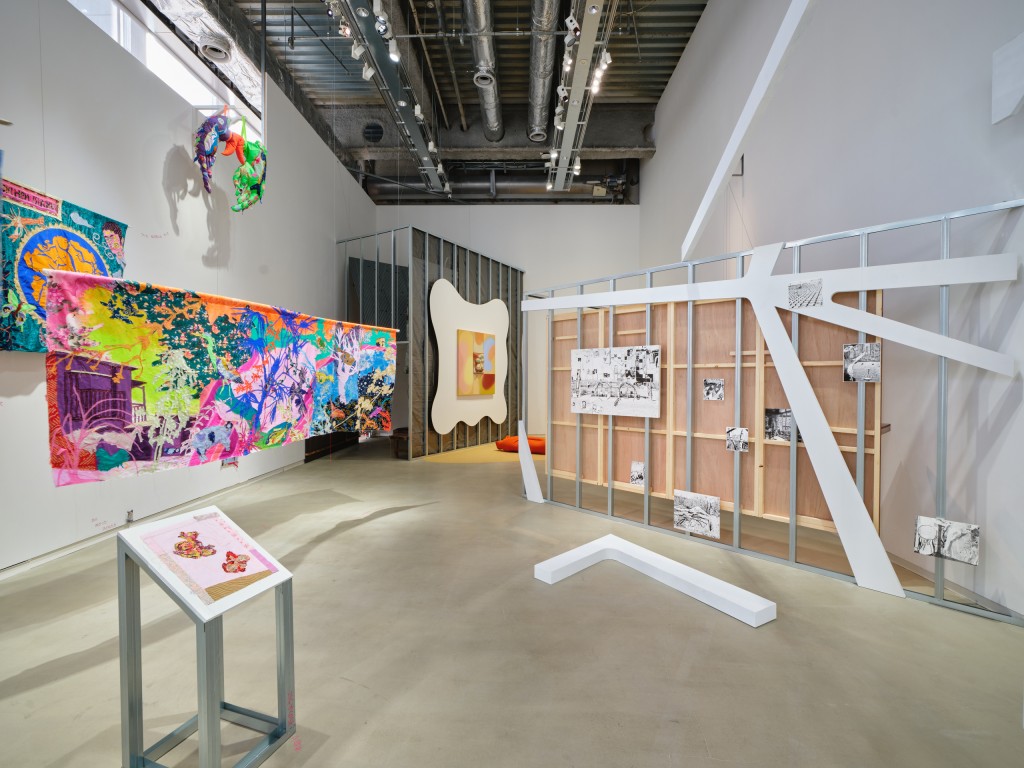
Behind the execution of an exhibition like this are innumerable conversations and negotiations. The exhibition would not have taken on this shape without the understanding of the participating artists, not to mention the dialogue between the BUG operations team, the curators, and Kohei Uchiumi, who designed the space. This is purely my speculation, but I suspect that Ikeda would have been the mediator between the operations team, the architect, and the artists, engaging in substantial long-term negotiations in order to realize this exhibition. In other words, she must have already had a certain vision, but rather than having a fixed final form in mind, she engaged in iterative dialogue, and landed on this arrangement as the result of trying to respect the artists’ intentions as much as possible. Rather than being a place unified under a strong direction, I feel that the exhibition emerges as the product of coordination and negotiation for the “right balance,” where each person’s voice is heard. This space is far from large, so it is not easy to segment it for the works of seven artists with any level of clarity, while also creating points of intersection that allows them to coexist. In that sense, the curatorial vision is evident throughout.
In this exhibition, each artist seems to create what they believe they “must do, right now” as an extension of their practice, rather than trying to do something “completely new” for this exhibition. That is why this exhibition doesn’t feel strained.
Aokid moves his body and draws pictures as a method of haptically exploring the city of Tokyo, and he continually updates his works through daily engagement with the site. Visitors are able to make many discoveries just by walking around the venue, and following the work provides a sense of the bodily traces and consciousness that spread in every direction.
Tatsuru Hatayama defines his own works as “paintings made with fabric.” To call the act of using fabric for image-making “painting” is, in itself, taking a critical position toward established views on painting and its hierarchy. It is also a declaration fitting of a non-Western artist from a younger generation. The paintings are produced by collaging colorful, vivid fabrics, and along with the words in the margins, they reveal the artist’s delicate sensitivity to the seemingly insignificant.
Mizuki Ashikawa draws the visitor’s eye with white, three-dimensional lines that freely traverse the exhibition space. Because the foundation of Ashikawa’s practice is in printmaking, a conventionally two-dimensional medium, there is a risk that adding three-dimensionality could slip into decoration, but the attitude of re-interpreting the act of printmaking more freely was courageous. I cannot wait for Ashikawa’s further explorations into working with the art of printmaking, while seeking to deviate from its order and rules.
Eri Yagi centered her exhibition around her paintings—using the existing white wall but also intervening in the space to install two dark brown wood-like screens and a table—while also presenting a piece where a half-fishman’s hand falls from mid-air onto the table. Introducing things that usually do not go together is the foundation of creation, especially in Surrealism, but the participatory programs surely enhanced the experience of sharing about the associative thinking and creative practice of connecting the half-fishman with various familiar social issues.
Kanoko Takaya’s works are characterized by elegant curved lines and colors of great depth, creating a calming space that can feel like a playground and also like a place of prayer. The subdued yellow floor gives a sense of safety. The intimacy between the tall three-dimensional object, which can be perceived as an object of worship, and the soft textile objects which are laid out on the floor, create a relationship of contrast, and adding a hybrid two/three-dimensional work, which can be seen as either painting or relief, brings a remarkable harmony to the installation as a whole.
Soil and fire are important structural elements for Kai Sakamoto, as he explores the act and process of creating ceramics, and what a life lived as an extension of that can look like. From his experience visiting Nagaland in northeast India, where he cooked Naga curry—an everyday meal there—and had conversations with people from Naga, he creates a place to reflect on what it is to live and to eat, and to kill living beings, as well as how our lives and expression make up one part of that cycle.
Graphic designer, forager, and printer Katsunobu Yoshida creates printed works using what he forages himself, and for this exhibition, he focuses on the principle of photography—capturing light to fix an image—and places multiple camera obscuras inside BUG. The cameras continue to gaze at the city and capture it, and this act of offering a never-ending, continuous series of moments becomes a response to the title “Moment Scape.” It is also characteristic of a forager that he continues to both shoot/forage (both “toru” in Japanese) the city, even without the artist’s body there.
As I describe each artist’s works and their activities, it becomes clear how different they all are. However, they all use their respective techniques, materials, and methods to think about “living,” and actively engage in BUG School as a place to share that with others, and by sincerely approaching the exhibition, participatory programs, and sales, each artist offers their own moment scape, enriching the exhibition.
The wealth of this exhibition’s web archive should also be noted. Online archiving is obviously a priority for BUG as an art center, but Minato Yamashita, who participates in this project as the operational assistant, has written concise and accurate reports for nearly all of the participatory programs. A school should be open to as many people as possible, with the capacity for those interested to get involved in various ways, and they should be able to “learn at any time.” BUG School offered various participatory programs, many of which were free, and through the meticulous reports of photos, video, and text, its aim to be an open school to people who could not visit is evident.
Illich defined things, models, peers, and elders as the four resources that are required for learning, arguing that places of learning should be “public spaces in which peers and elders outside his immediate horizon would become available,”5 and repeatedly asserted the importance of accessibility for everybody. The intention of this project’s archive overlaps with the idea of the deschooled institution that Illich proposed, and is the embodiment of what is desired of an art center. This exhibition draws attention to this attitude that an art center, which is categorized as a social education facility, should essentially be “a place of learning that is open to anyone” and I am once again struck by the significance of this endeavor.
1. Ivan Illich, Deschooling Society, trans. Hiroshi Azuma and Shuzo Ozawa (Tokyo Sogensha, 1977), 13.
2. Shiroto no Ran is a group based in Koenji, Tokyo, that runs a secondhand shop/cafe/event space and has been active since the 2000s. Centered around Hajime Matsumoto, who runs the group, they are known for activities where activism, creating communal spaces, and everyday practices intersect.
3. BUG School 2024 : Feeling Cities with Wild Sense. Wednesday, December 18, 2024–Sunday, February 2, 2025. https://bug.art/exhibition/bugschool-2024/
4. Referencing Yoshihiko Amino, Muen・Kugai・Raku—Nihon Chusei no Jiyuu to Heiwa (Zouho) [No relations, public spheres, freedom—freedom and peace in medieval Japan (expanded edition)] (Heibonsha Library, 1996 [first published in 1978]) and Kinya Abe, Chuusei no Hoshi no Moto de [Under the stars in medieval times] (Chikuma Gakugei Bunko, 2010) as discourse that connected the market with concepts such as “muen” (having no relations), and “kugai” (the public world).
5. Ivan Illich, Deschooling Society, trans. Hiroshi Azuma and Shuzo Ozawa (Tokyo Sogensha, 1977), 142.